
Skip Navigation
June, 02, 2026  |  Charlie Southwood  |    |    | 

Junxion’s Guide to the ECGT Directive

The Empowering Consumers for the Green Transition Directive (ECGT) is both a legal wake‑up call on greenwashing and a strategic opportunity to build more honest communications.

Charlie Southwood
is a Consultant & Marketing Manager at Junxion. He's passionate about the role brands play in creating a better future.

Empowering Consumers for the Green Transition might sound like another dense piece of EU legislation but it’s a gamechanger. 

For years, consumers have been asked to trust sweeping promises from companies: “eco‑friendly,” “carbon neutral,” “sustainable by 2030.” Some of those claims are grounded in genuine action, but many are not. The new Directive is the EU’s answer to that claim vs. credibility gap, requiring companies to provide real evidence to back up green claims.

This Directive is not just a compliance necessity, though; it is an opportunity. Aligning with the Directive can strengthen your impact story, build trust with your customers, and future‑proof your brand in a world that is rapidly losing patience with greenwashing and the lack of progress on climate and nature. 

What is the ECGT Directive? And What’s it For?

Coming into effect on 27 September 2026, the ECGT directive aims to protect consumers from greenwashing and misleading product information. It expands the ‘blacklist’ of commercial practices that are always considered unfair, adding specific greenwashing and early obsolescence practices to the list.

The Directive applies to any trader engaging in business‑to‑consumer (B2C) commercial practices in the EU, regardless of where the company is headquartered. If you sell directly to EU consumers—online or offline—and you make environmental or social claims about your products or services, you are in scope.

It is strictly limited to B2C practices: business‑to‑business communications and most corporate sustainability reporting (including CSRD‑driven disclosures aimed at investors) are generally out of scope. That distinction is important: ECGT is about how you talk to customers, not how you report to markets or regulators.

ECGT is about how you talk to customers, not how you report to markets or regulators
What Are the Key Obligations? 

For consumer‑facing companies, the Directive requires you to…

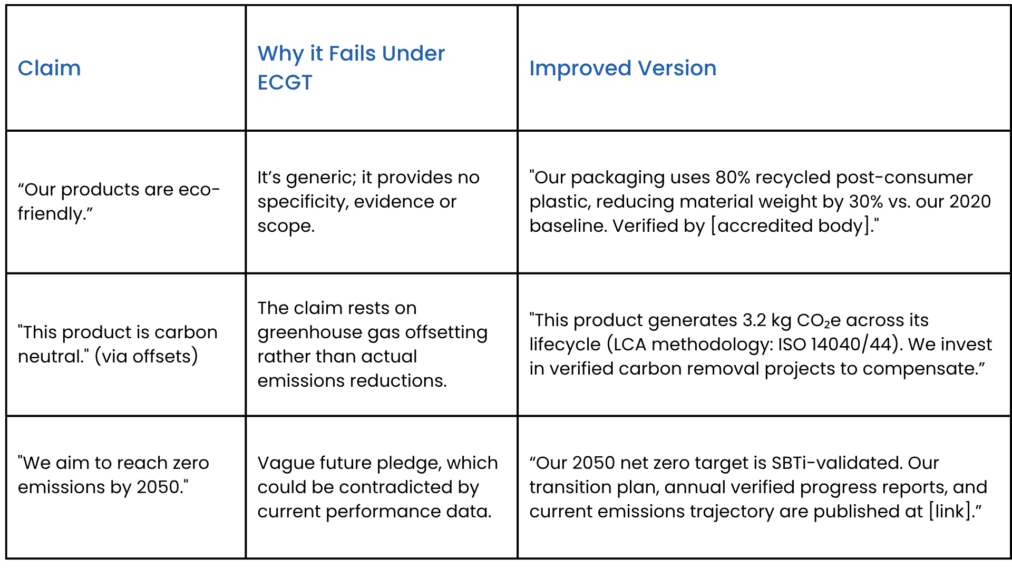
  • Avoid generic, vague environmental claims like “eco‑friendly”, “green” or “sustainable” unless you can demonstrate recognised environmental performance relevant to the claim.
  • Stop claiming that an entire product or the whole business is environmentally beneficial when the claim only relates to a specific aspect or activity. For example, “We are a sustainable fashion brand” (because one of your clothing lines is organic) is misleading, so not allowed.
  • Stop using claims like “climate neutral” or “carbon positive” based solely on offsetting, without robust evidence and recognised methodologies.
  • Only use sustainability labels that are based on recognised certification schemes or established by public authorities; self‑invented logos and unverifiable badges are prohibited.
  • Provide clear pre‑purchase information about durability, repairability, availability of spare parts and software updates, so consumers can make informed choices before they commit. 

Example Claims 

Who Can Make an Infringement Claim?

There are several enforcement approaches. National authorities in the member states where you sell can launch investigations entirely on their own initiative, through routine sweeps of packaging and marketing materials, or simply because a claim comes to their attention. Individual consumers and competitors can file a complaint with a national authority, which then decides whether to act. And qualified entities can bring a representative action directly before a court without needing the regulator to act. 

What’s the Penalty? 

If a company fails to comply with the legal process or the infringement is serious, the authority can impose fines of up to 4% of annual income (higher in some Member States), require public corrections, or seek injunctions to stop the practice immediately.

Does ECGT Ruin Copywriting? 

With the need for more technical details on touchpoints, might there be a risk that sustainability communications will become dry and unengaging? A company might replace “planet‑friendly bottle” with “bottle made with 80% rPET, LCA performed to ISO 14040/44.” The intention to be precise and defensible is good, but the effect is that everything may start to read technically accurate, but emotionally flat.

In fact, ECGT does not mean all copywriting must become legalese; it’s just that you mustn’t mislead your audiences and leave out material information. That still leaves you a lot of room to be human, playful, and provocative, as long as the claims are specific and evidenced.

Here are three ways to keep your communications inspiring and engaging:

  1. Your brand personality can still shine through. While the claim has to be precise, the story around the claim can still be as bold or distinctive as you like. Think Innocent’s pioneering of wackaging. For example, you could lean into fun with something like: “We shrank ourselves! 22% less material than in 2021, same amount of tea inside. Details at XYZ”
  2. Keep claims short. You don’t need paragraph-long caveats like “the primary container comprises 100% post‑consumer recycled plastic and the closure components (including cap and pump) do not yet contain recycled content.” You can use short, honest lines like “Bottle: 100% recycled plastic. Cap and pump: not yet.”
  3. Use visual design to bring excitement. Visual language can help convey sustainability information in an engaging way. Consider a progress bar showing recycled content over time, a colour-coded materials map, or an on-brand QR code. 

Oatly does a great job of communicating its environmental impact in a visual way

Tempted to Greenhush?

With the risk of fines and hits to public reputation, marketers may also feel tempted to go quiet on the brand’s sustainability progress. This is known as greenhushing. This may seem like a good idea, but brands that go silent are ceding ground to the ones willing to tell a more specific, credible, and engaging sustainability story. Employees, investors, customers and procurement teams are all increasingly asking whether the companies they work with, buy from, and back are making genuine progress on sustainability. The goal is not to go quiet but instead tell your sustainability story in a way that’s honest about where you currently are in your journey with specific, evidence-based context. 

How Does ECGT Affect B Corps? 

Under ECGT, sustainability labels can only be used in consumer claims if they meet strict conditions, including transparent criteria and monitoring by an independent third party, or if they are established by a public authority. 

That means the old B Corp model, where B Lab set the standard and did the verification itself, was not fully compliant with ECGT’s independence expectations. However, with B Lab’s new standards, assessments are verified by accredited, independent assurance providers, which means the mark is a valid sustainability label.

Tell your sustainability story in a way that’s honest about where you currently are in your journey

All B Corps that are in scope of ECGT must ensure they’re on the new standards by 27 September 2026. (If this is you, get in touch right away: we’re expediting certifications under the new standards for companies affected by ECGT.)

It’s important to note that being a B Corp does not grant automatic ECGT compliance. Many B Corps will still need to…

  • Audit consumer‑facing claims (web, packaging, ads) to remove generic language and align with ECGT’s evidentiary expectations.
  • Review how they describe certification and impact so that claims about being a sustainable business do not overreach beyond verified performance.
  • Strengthen internal governance across legal, marketing, sustainability, and product teams to ensure consistent, compliant ESG communications.
  • Use the new B Corp logo, which has the URL underneath.

Why Businesses Outside Scope Should Still Align

Even if you are not directly in scope of the ECGT Directive, aligning with ECGT is still strategically valuable. EU consumer law often sets de facto global norms. Similar rules on green claims are emerging in other jurisdictions (the UK has the Green Claims Code and Canada is strengthening its Competition Act, so aligning now helps you reduce future transition costs. There’s also a trust piece: clarity, specificity, and evidence for environmental and social claims build consumer and stakeholder trust, whether the law applies or not. 

Next Steps For Your Company

Whether or not you are directly regulated, you can use ECGT as a prompt for better impact storytelling and governance:

  1. Map your consumer‑facing claims: Gather website copy, packaging, campaigns, sales scripts, and app content.​
  2. Classify claims: Identify which claims are generic (“green”, “eco‑friendly”), which are specific but weakly evidenced, and which are robust.
  3. Strengthen evidence: For priority claims, produce clear methodologies, certifications, and governance processes to meet ECGT‑level scrutiny.
  4. Align labels and badges: Retire self‑created sustainability icons and lean on recognised certification schemes that meet ECGT’s minimum criteria.
  5. Update your narrative: Rewrite key consumer touchpoints to focus on specific, verifiable benefits, lifecycle information, durability, and repairability, rather than broad promises.

Done well, this is far more than a compliance exercise. It is a powerful way to align what you say, what you do, and how you are governed—exactly the alignment that purpose‑led businesses have been working towards for years.​

If you’d like help navigating the ECGT Directive or tightening your green claims, send us an email at [email protected]